How to write a slogan that connects:
Ever wonder how to write an exceptional tagline? One that is memorable? That embodies the essence of the brand? And creates an emotional connection between the consumer and brand?
Catchy taglines share some common ground. The following insights can help you create slogans that connect:
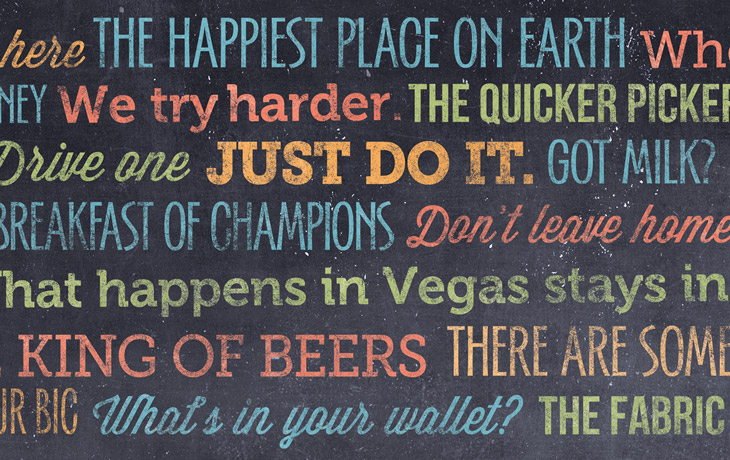
1) They sell the benefits, not the features. Take Disney’s memorable tag “The Happiest Place on Earth.” Instantly you get a feeling, a sense of the experience, without the details. It is the essence of the value that a visit to Disneyland imparts.
To develop an outstanding tagline, first look at the benefits your product provides. What are the key messages you want to leave with the consumer? What kind of personality does your brand represent? Disney’s slogan captures their brand promise so perfectly!
Another strong example of a slogan that sums up the brand benefit beautifully is Bounty’s “The quicker picker-upper.” Extra points for the rhyme they established. It acts like a mini earworm; perhaps it’s why this slogan lasted for decades. In 2010 the company tried to drop the phrase, changing the paper towel’s focus to “competent clean” – who knew? It failed, and the favorite is back (at least online).
2) They are short and sweet. “Just Do It.” is arguably one of the best-known slogans of the 20th century. Created in 1988 by advertising agency Wieden+Kennedy, Dan Wieden credits the slogan’s inspiration to criminal Gary Gilmore’s famous last words before his execution, “Let’s do it.” Dan’s refinement adds emphasis and attitude to tagline. The slogan works so beautifully because it is simple, and allows consumers to connect to the Nike brand in their own personal way.
Another noteworthy example is “Got Milk?” In 1993, the California Milk Processor Board was concerned about the rise in soda drinking and subsequent decline in milk sales. Their goal was simply to make drinking milk cool again. A brilliant component of their strategy was visual. The slogan was paired with iconic photos of celebrities sporting a milk mustache. Before long this tagline became a meme and was parodied endlessly, providing free advertising for their product!
Creating a memorable line is challenging. Distilling a complex emotional concept to a few words requires imagination! It helps to clearly define your brand essence. What is the key benefit? If you get nothing else from an ad besides the tagline, what does it convey?
3) They differentiate the brand personality from the competition. “We try harder.” Paula Green, copywriter with agency Doyle Dane Bernbach, created this line in 1963 for a campaign that became an instant hit for Avis Rent a Car. An underdog to Hertz, they associated being # 2 with striving to please the customer. Paired with exceptional ad concepts, the tagline turned their business around, and endured for 50 years!
“The Breakfast of Champions” has been around since 1935. Everyone knows Wheaties and their iconic packaging featuring athletes. For 80 years, Wheaties has differentiated their brand as a healthy way to start the day. It’s a food for achievers!
Make your tagline authentic and believable. Plan how it will be used to define the brand within advertising, packaging and on social media. The tone should match your brand personality, but be sure it doesn’t blend with your competitors’ messaging.
4) Words are carefully considered. Nothing more than necessary stays in. There is a trend to go with short taglines, but these lines might miss an emotional connection that is necessary. “Take Charge.” Whose tag is that? How about “Drive one.”? Or “Turn here.”? If you don’t recognize those, you’re probably not alone. (See the end of this post for answers.)
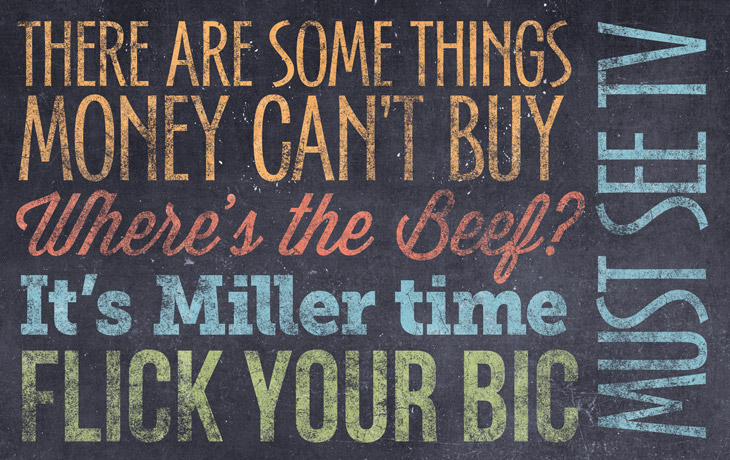
Longer taglines have to be tight. Make every word count. “There are some things money can’t buy. For everything else, there’s MasterCard.” 12 words! This tagline was paired with commercials that highlight truly important things in life. It resonates at an emotional level even when the supporting ad isn’t presented.
5) They are not necessarily a statement. An informational statement is certainly the most straightforward tagline: “The king of beers” for instance, is a distinctive declaration for Budweiser. But another approach is to arouse emotion with a question, a command, or with humor. “What’s in your wallet?” makes you stop and think about your credit card (Capitol One), while “Don’t leave home without it” is even more forceful (hinting that horrible things could befall you if you forget your American Express!)
“Flick Your Bic” manages to sound slightly naughty, while “Where’s the Beef?” is even more risqué! Both of these slogans (for Bic lighters and Wendy’s burgers) are iconic without spelling out what the product is.
What can make a tagline drop like a sinker? Buzzwords kill. Leave words like “synergy,” “innovation,” and “global” out. These are so overused that the consumer will ignore them. Your phrasing should be original and easily understandable, not derivative.
Bland is boring. The safe choice may be just that, but it won’t inspire your customer. It is not about what you want to say about your brand. It’s how your audience wants to feel. Think of your tagline as a bridge connecting your brand to the consumer. A bridge built on emotion.
—
Whose tag is that?
“Take Charge.” American Express. “Drive one.” Ford. “Turn here.” Fidelity. At least with the first two, the subject matter is hinted at, but they leave you uninspired. “Turn here.” is even more vague.